
Screen any wallet.
$0.15 per check.
Check any wallet address or transaction hash for on-chain risk, sanctions, mixers, darknet exposure, source of funds. $0.15 per check, or bring your own screening provider.
 Robinhood Ventures





Trusted by 2,000+ organizations worldwide.
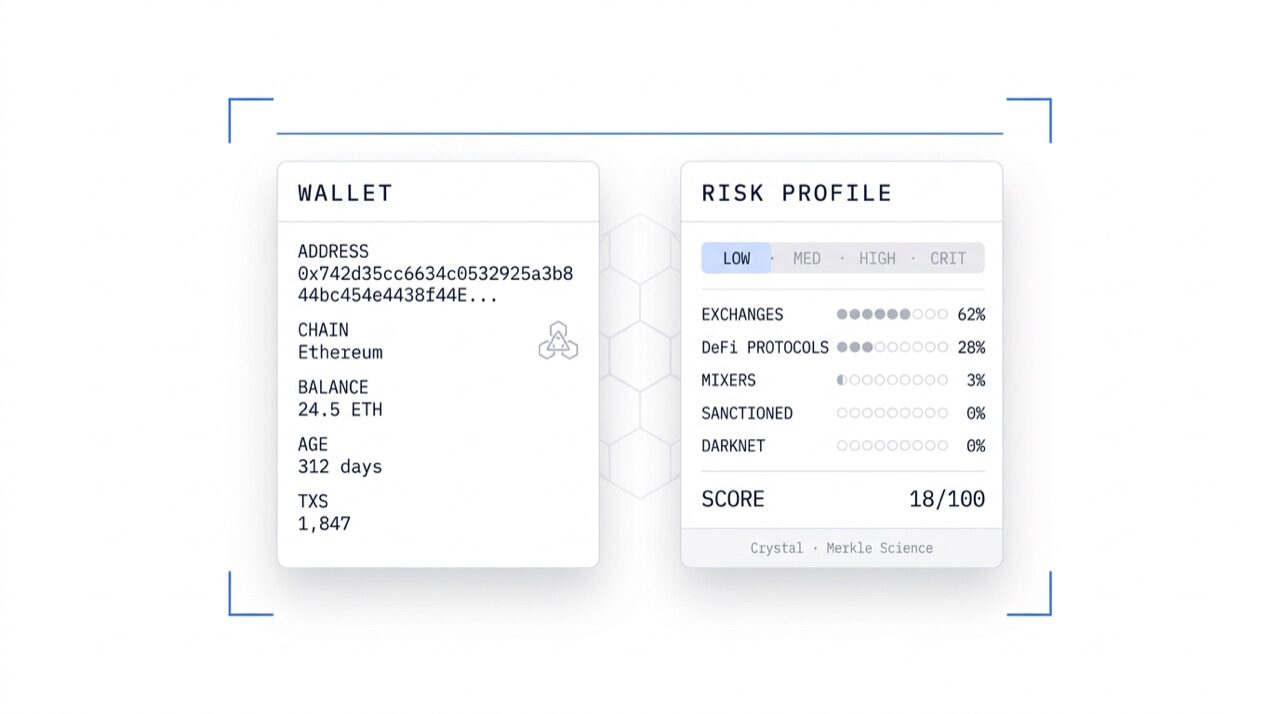
$0.15 per check
On-chain wallet risk.
One public price.
Screen wallets at $0.15 per check, or bring your own screening provider and run it inside Didit, with one case queue and one audit trail across both.
From sign-up to verified user in four steps.
- Step 01
Create the workflow
Pick the checks you want, ID, liveness, face match, sanctions, address, age, phone, email, custom questions. Drag them into a flow in the dashboard, or post the same flow to our API. Branch on conditions, run A/B tests, no code required.
- Step 02
Integrate
Embed natively with our Web, iOS, Android, React Native, or Flutter SDK. Redirect to a hosted page. Or just send your user a link, by email, SMS, WhatsApp, anywhere. Pick what fits your stack.
- Step 03
User goes through the flow
Didit hosts the camera, the lighting cues, the mobile hand-off, and accessibility. While the user is in the flow, we score 200+ fraud signals in real time and verify every field against authoritative data sources. Result in under two seconds.
- Step 04
You receive the results
Real-time signed webhooks keep your database in sync the moment a user is approved, declined, or sent to review. Poll the API on demand. Or open the console to inspect every session, every signal, and manage cases your way.
Six capabilities. One module. $0.15 per check.
Bring your own screening provider.
- DefaultDidit-managed screeningConnected · $0.15 / check
- Your screening providerConnected · your key
- Add another providerAvailable
One public price per check.
Real-time wallet risk in sub-second.
- Sanctioned wallet28%
- Mixer (Tornado Cash)12%
- Regulated exchange48%
- P2P12%
FATF Recommendation 16 and VASP compliance.
- originator.full_name · date_of_birth
- beneficiary.full_name · wallet_address
- amount · currency · chain
Chains straight into Transaction Monitoring.
- 1TM rule · velocity checkPASS
- 2Wallet Screening · on-chain riskFLAG
- 3Rule engine · status updateAWAITING_USER
Sanctions, OFAC, darknet, mixers, ransomware.
- ActiveOFAC SDNUS Treasury
- ActiveEU consolidatedEuropean Council
- ActiveUN sanctionsUnited Nations
- ActiveDarknet marketsProvider intelligence
- ActiveRansomware walletsProvider intelligence
Open a new country in one click. We do the hard work.


Common questions
What is Didit?
Didit is infrastructure for identity and fraud, the platform we wished existed when we were building products ourselves: open, flexible, and developer-friendly, so it works as a real part of your stack instead of a black box you integrate around.
One API covers verifying people (KYC, know your customer), verifying businesses (KYB, know your business), screening crypto wallets (KYT, know your transaction), and monitoring transactions in real time, on a stack built to be:
- Fast, sub-2-second p99 on every session
- Reliable, in production with 2,000+ companies across 220+ countries
- Secure, SOC 2 Type 1 & Type 2, ISO 27001, GDPR-native, and formally attested by Spain's financial regulator as safer than verifying someone in person
The footprint underneath: 14,000+ document types in 48+ languages, 1,000+ data sources, and 200+ fraud signals on every session. The Didit infrastructure dynamically learns from every session and gets better every day.
What is Wallet Screening (KYT)?
Wallet Screening, also called Know Your Transaction (KYT), assesses on-chain risk on a crypto wallet address or transaction hash. Sanctions exposure, darknet markets, ransomware wallets, mixers, stolen-funds counterparties, scam wallets, terrorist financing, surfaced as a risk score, a severity tier, a source-of-funds breakdown, and discrete flags you can route on in real time.
$0.15 per check screened end to end inside Didit, or bring your own screening provider and run it inside Didit on the same /v3/ Application Programming Interface (API) contract, with unified casework and audit.
Full reference: docs.didit.me/core-technology/wallet-screening/overview.
What does Wallet Screening cost?
$0.15 per check screened end to end inside Didit, one public price, no separate analytics contract to manage.
If you already have a screening provider you prefer, you can bring your own screening provider and run it inside Didit, paste your provider key into the Business Console, every screening Didit dispatches uses your key, and the screening counts against your existing provider contract.
No minimums, no contract, no overage surprises. Switch between modes per workspace at Transactions → Settings → Provider Preferences.
How fast is the verification for my end user?
The full flow normally takes under 30 seconds end-to-end, pick up the ID, snap the document, snap the selfie, done. That is the fastest in the market. Legacy KYC providers usually take more than 90 seconds for the same flow.
On the back end, Didit returns the result in under two seconds at p99, measured from the moment the user finishes the selfie to the moment your webhook fires. Mobile capture is tuned for slow phones and slow networks: progressive image compression, lazy software development kit load, and a one-tap hand-off from desktop to phone via QR code if the user starts on web.
What is the response shape?
A standardised payload regardless of which provider sits behind it.
risk_score,0–100, higher means greater exposure.severity,LOW,MEDIUM,HIGH,CRITICAL.source_of_funds, breakdown across 14+ categories (sanctioned wallet, terrorist financing, child exploitation, ransomware, stolen funds, darknet markets, mixers, scams, high-risk exchanges, gambling, regulated exchanges, peer-to-peer, unidentified services).exposure, counterparty entities with direct vs indirect hop distance, plus received and sent amounts.network_graph, centrality and depth metrics.flags, discrete signals likesanctioned,darknet_market,mixer,ransomware.
Same shape lands inside the Transaction Monitoring response.
What happens if a user fails, abandons, or expires?
Every session lands on one of seven clear statuses, so your code always knows what to do:
Approved, every check passed. Move the user forward.Declined, one or more checks failed. You can allow the user to resubmit the specific failed step (for example, re-take the selfie) without re-running the whole flow.In Review, flagged for compliance review. Open the case in the console, see every signal, decide approve or decline.In Progress, user is mid-flow.Not Started, link sent, user has not opened it yet. Send a reminder if it sits too long.Abandoned, user opened the link but did not finish in time. Re-engage or expire.Expired, the session link aged out. Create a new session.
A signed webhook fires on every status change, so your database always stays in sync. Abandoned and declined sessions are free.
Where does my customer data live and how is it protected?
Production data is processed and stored in the European Union by default, on Amazon Web Services. Enterprise contracts can request alternative regions for jurisdictions whose regulators require it.
Encryption everywhere. AES-256 at rest across every database, object store, and backup. Transport Layer Security 1.3 in transit on every API call, webhook, and Business Console session. Biometric data is encrypted under a separate Customer Master Key.
Retention is yours to control. Default retention is indefinite (unlimited) unless you configure shorter, between 30 days and 10 years per application, and you can delete any individual session at any time from the dashboard or the API.
Certifications: SOC 2 Type 1 & Type 2, ISO/IEC 27001:2022, iBeta Level 1 Presentation Attack Detection (PAD), and a public attestation from Spain''s Tesoro / SEPBLAC / CNMV that Didit''s remote identity verification is safer than verifying someone in person. Full report at /security-compliance.
Is Didit compliant for my industry?
Didit ships compliant by default for the regulators that matter to identity infrastructure:
- GDPR + UK GDPR, controller / processor split, full Data Processing Agreement published, lead supervisory authority named (Spain''s AEPD).
- AMLD6 + European Union Anti-Money Laundering (AML) Single Rulebook, 1,300+ sanctions, politically exposed person, and adverse-media lists screened in real time.
- eIDAS 2.0, EU Digital Identity Wallet aligned; reusable-identity ready.
- MiCA (Markets in Crypto-Assets), ready for crypto on-ramps, exchanges, and custodians.
- DORA, Digital Operational Resilience Act, EU financial-services operational resilience.
- BIPA, CUBI, Washington HB 1493, CCPA / CPRA, US biometric privacy (Illinois, Texas, Washington) and California consumer privacy.
- UK Online Safety Act, age-gating and child-safety obligations.
- FATF Travel Rule, originator and beneficiary data on crypto transfers, IVMS-101 interoperable.
Detailed memo, every certificate, every regulator letter: /security-compliance.
How fast can I integrate and start verifying users?
- 60 seconds to a sandbox account at , no credit card.
- 5 minutes to a working verification through Claude Code, Cursor, or any coding agent via our Model Context Protocol (MCP) server.
- A weekend to a production-ready integration with signed-webhook verification, retries, and a remediation flow when a user is declined.
Three integration paths, pick whichever fits your stack:
- Embed natively with our Web, iOS, Android, React Native, or Flutter SDK.
- Redirect the user to the hosted verification page, zero SDK.
- Send a link by email, SMS, WhatsApp, or any channel, zero front-end work.
Same dashboard, same billing, same pay-per-success price for all three. Step-by-step guide at .
Infrastructure for identity and fraud.
One API for KYC, KYB, Transaction Monitoring, and Wallet Screening. Integrate in 5 minutes.